Johann Sebastian Bach
1685 – 1750 · Baroque
Johann Sebastian Bach is the central figure of the late Baroque keyboard tradition and, by common agreement, the greatest contrapuntist in W…
216 scores
Free · Public Domain · IMSLP-Sourced
A working library of 1,392 public-domain piano scores from the Baroque to the Impressionist — Bach, Mozart, Beethoven, Chopin, Schubert, Debussy and beyond. Browse, study, print, perform.
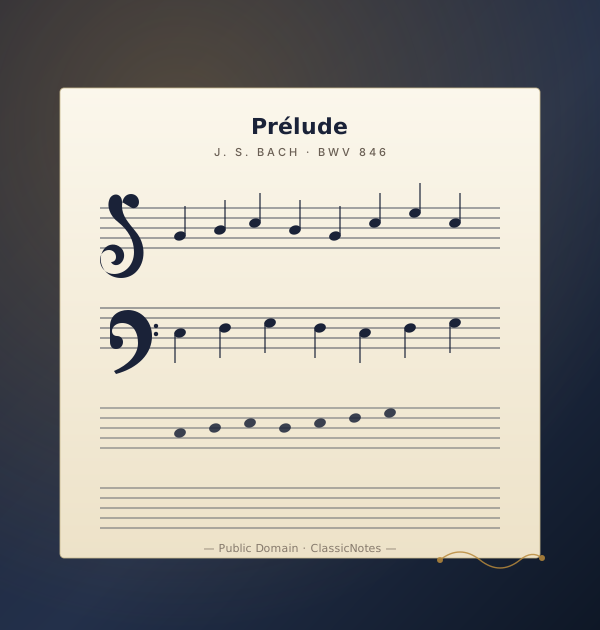
Johann Sebastian Bach is the central figure of the late Baroque keyboard tradition and, by common agreement, the greatest contrapuntist in W…
Joseph Haydn wrote more than fifty keyboard sonatas across a career that effectively invented the Classical sonata. Wit, surprise, and a pro…
Frédéric Chopin wrote almost exclusively for the piano. His preludes, études, nocturnes, ballades, scherzos, polonaises, mazurkas, and waltz…
Ludwig van Beethoven's thirty-two piano sonatas form the most important single body of work in the keyboard repertoire — what Hans von Bülow…
Domenico Scarlatti wrote 555 single-movement keyboard sonatas, mostly in binary form, that combine Iberian guitar idioms, daring harmonic sh…
Johannes Brahms's piano music spans the early sonatas, the Paganini and Handel variation sets, and a final great body of late character piec…
Wolfgang Amadeus Mozart wrote eighteen numbered piano sonatas, two dozen sets of variations, and a small constellation of fantasias and rond…
Robert Schumann's piano cycles — Carnaval, Kreisleriana, Davidsbündlertänze, Kinderszenen, Fantasiestücke, the Symphonic Etudes — invented t…
The Baroque era brought the keyboard from the harpsichord and clavichord to its expressive zenith. Counterpoint, dance suites, fugues, and ornamentation define …
The Classical era refined keyboard music around the new fortepiano, favoring balanced phrases, clear textures, and sonata-form drama. Mozart, Haydn, and the ear…
The Romantic era turned the piano into an orchestra under ten fingers. Chopin, Schumann, Schubert, Liszt, Brahms, and Mendelssohn pushed expression toward the p…
The late Romantic era extended Romantic intensity into chromatic, large-scale works by Rachmaninoff, Scriabin, Fauré, and the late Brahms. Harmonic ambiguity an…
Debussy, Ravel, and their contemporaries reimagined the piano as a vehicle for color, perfume, and atmosphere. Modal scales, parallel chords, and pedal effects …
Chord Barn is a free, advertising-supported reference for the public-domain piano repertoire. Every work in the library is in the public domain in the United States and in most jurisdictions worldwide; you can download, print, study, perform, record, and re-engrave any score here without restriction.
Catalog data and PDF score files are sourced from the IMSLP / Petrucci Music Library, the volunteer-maintained archive that has spent two decades digitizing the canonical engraved editions of the nineteenth and early twentieth centuries. We organize that material by composer, by era, by key, by form, by decade of composition, and by technical difficulty — so that pianists, students, teachers, and curious listeners can find what they need quickly.
The library is a working tool, not a finished encyclopedia. New entries are added regularly, and editorial notes are expanded as research permits. Read more about the project or read about the public-domain status of the works.